Read Time: 5 minutes
When you’re building or specifying a rooftop patio, the adjustable pedestal system matters just as much as the paver. The wrong pedestal leads to added labor, delays during installation due to missing parts, and costly on-site adjustments. The right adjustable pedestal gives you a level, stable, long-lasting surface that performs in harsh rooftop environments.
This guide covers what adjustable pedestals do, the different pedestal system types on the market, how they compare, and why choosing the right style up front can save you a ton of time and labor.
What This Article Covers
- What adjustable pedestals actually do
- The three main pedestal system types used on rooftops
- Advantages and disadvantages of each system type
- Height ranges, slope, drainage, and wind uplift considerations
- How to choose the right pedestal system for your project
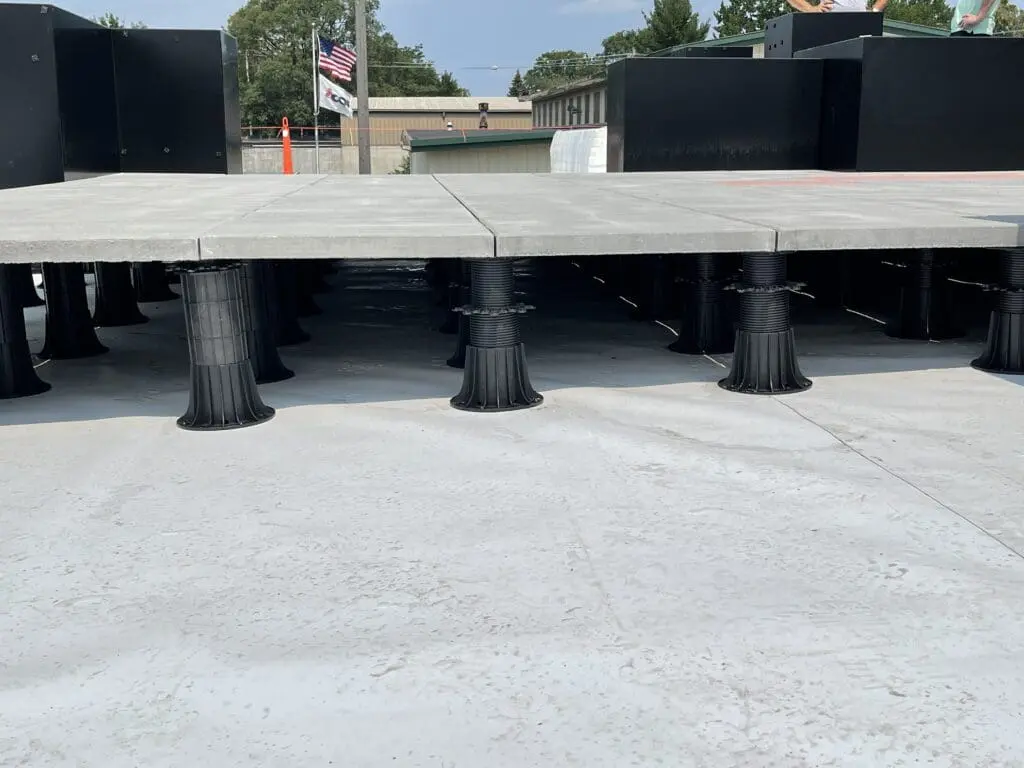
1. What Adjustable Pedestals Do (and Why Rooftops Require Them)
Adjustable pedestals create a level walking surface on top of an uneven roof. Roofs are built to move water, not people, so they typically include:
- Built-in slope
- Tapered insulation
- Low spots, high spots, and drain bowls
- Membrane transitions and seams
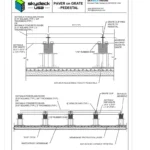
Pedestals solve these issues by providing adjustable support under pavers, decking, or FRP grates while maintaining:
- Positive drainage under the surface
- A flat finished plane for walking
- Airflow and dry-out under the assembly
- Protection of the roofing membrane
2. The Three Main Types of Adjustable Pedestal Systems
In the rooftop world, most systems fall into one of three categories:
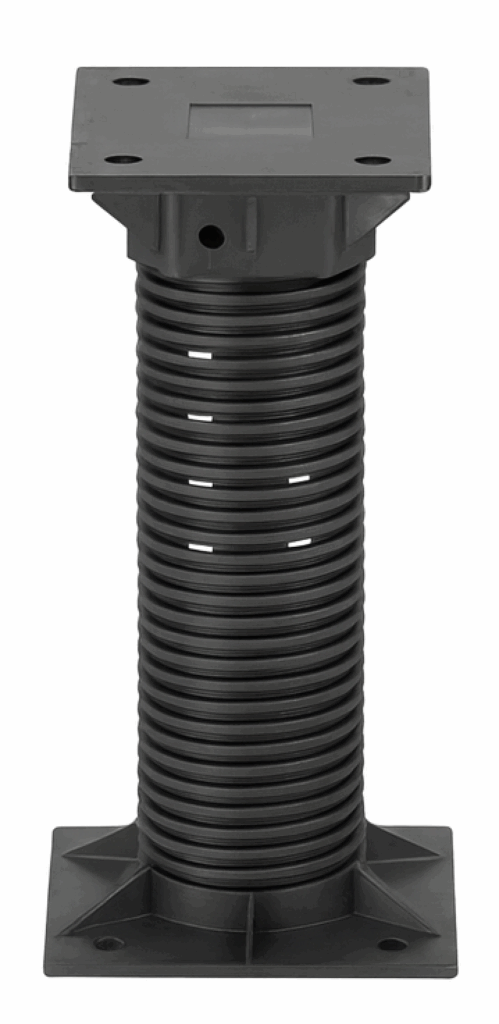
- Fully adjustable, factory-assembled pedestals
- PVC tube–based systems (cut pipe + separate heads/bases)
- Stacked ring systems (multiple rings built up to height)
Let’s break these down.
Type 1: Fully Adjustable Pedestals (Factory-Assembled)
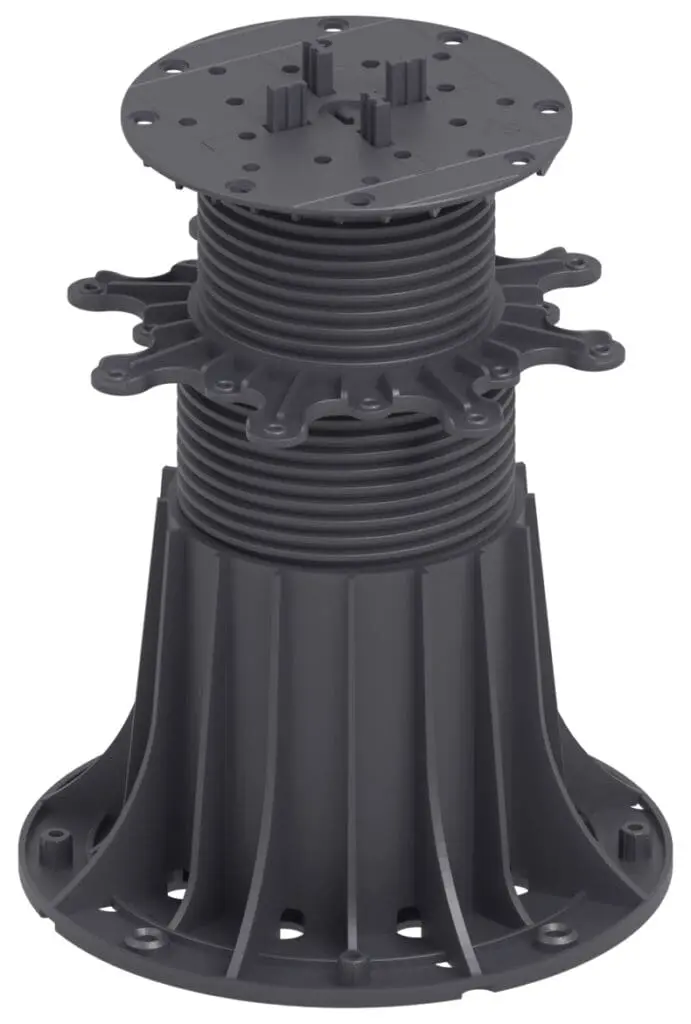
These arrive as complete, adjustable units with threaded or modular height adjustment built in. Most also offer time-saving accessories designed specifically for rooftop work:
- Self-leveling heads
- Base slope correctors
- Shims
- Perimeter spacers / wall clips
- Wind uplift accessories
How they work:
You set the pedestal roughly to height, place it, fine-tune adjustment from the top, then drop in pavers, tiles, grates, or joists.
Type 2: PVC Tube Pedestal Systems (Cut Pipe Builds)
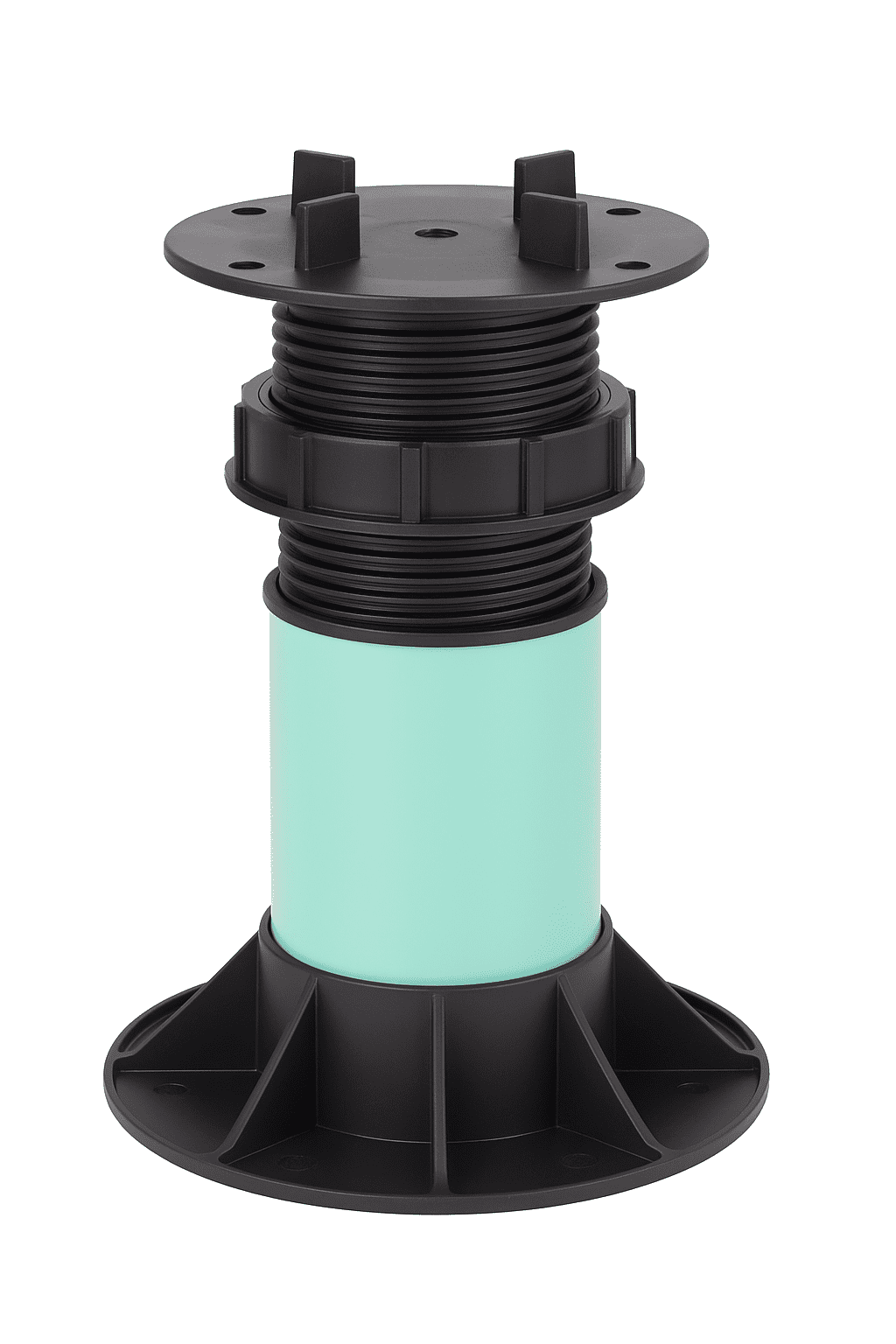
These systems use:
- A separate base
- A length of PVC pipe cut onsite
- A top head that sits on the PVC
Installers buy PVC pipe locally, cut each length to the required height, and assemble the components on the roof.
How they work:
You measure the height needed at each location, cut PVC pipe to size, place the base, insert the pipe, attach the head, then set the paver or tile. Some systems allow for a bit of adjustments once assembled.
Type 3: Stacked Ring Systems
These use multiple plastic rings or discs stacked on top of each other until the desired height is reached. Sometimes there are small adjusters or spacers, but most of the height is created by physically stacking enough rings.
How they work:
You determine approximately how many rings are needed at each location, stack them, then screw the assembly together using base and cap pieces.
3. Pros and Cons: Comparing Pedestal System Types
A. All-Inclusive vs Extra Parts Required
Fully Adjustable (Type 1)
- All-inclusive: pedestals arrive as complete units.
- Accessories (self-leveling heads, slope bases, wall clips, wind plates) are designed to click into the system.
- No additional parts needed
PVC Tube Systems (Type 2)
- Extra parts required: you must separately source PVC pipe.
- The system depends on site-cut pipe, so component quality and consistency vary with the pipe used.
Stacked Rings (Type 3)
- Usually all plastic parts from the manufacturer
- You need to stack rings on top of each other on-site to reach pedestal heights required then screw on the base and cap pieces
B. Assembly Required Onsite vs Fully Assembled Delivery
Fully Adjustable (Type 1)
- Delivered ready to use.
- Minimal onsite assembly (maybe snapping on a slope corrector or head).
- You’re adjusting, not “building” the pedestal.
PVC Tube Systems (Type 2)
- Heavy onsite assembly burden.
- Each pedestal requires:
- Measuring height
- Cutting PVC
- Deburring ends
- Assembly of base + pipe + head
- More tools, more steps, more room for inconsistency.
Stacked Rings (Type 3)
- Onsite assembly of multiple rings per support.
- Higher heights = more rings = more stacking.
- More assembling and disassembling to match exact pedestal height needs
C. Simplicity to Estimate
Fully Adjustable (Type 1)
- Requires onsite measurements to estimate accurately.
- Pedestal manufacturers should provide a shop drawing with pedestal height layout
- Add accessories based on:
- Height thresholds
- Slope requirements
- Wind uplift conditions
PVC Tube Systems (Type 2)
- Estimating parts from manufacturer is easy. Calculating PVC quantities is trickier.
- Pedestal head count
- Base count
- PVC pipe length (total linear feet)
- Cut scrap/waste
- And the labor to cut and assemble is harder to quantify in a simple estimate.
Stacked Rings (Type 3)
- Estimating requires figuring out:
- How many rings per location
- How many of each ring size by height band
- Since parts are interchangeable, it’s better to use a higher waste factor so you don’t run out. But, that costs more and may leave you with lots of extra parts.
D. Simplicity to Install
Fully Adjustable (Type 1)
- Most straightforward for crews.
- One consistent product family.
- Installers get comfortable with:
- Height adjustment
- Leveling routine
- Accessory snap-ons
- Fewer decisions per pedestal once the layout is established.
PVC Tube Systems (Type 2)
- Installers must:
- Set up cutting stations
- Handle power tools / saws
- Measure heights accurately
- Keep track of many small pieces
- More skill-dependent and more error-prone.
Stacked Rings (Type 3)
- Simple conceptually, but:
- Repetitive stacking is tedious
- Easy to get one ring off in a stack and end up with uneven planes that need to be disassembled and reassembled
- Harder to “fine-tune” heights compared to a threaded pedestal system
E. Time in Labor Required to Install
Fully Adjustable (Type 1)
- Lowest labor per pedestal in most rooftop scenarios.
- Most of the time is spent on layout + fine tuning by the manufacturer, not labor on the jobsite.
- New installers can learn how to use the system quickly.
PVC Tube Systems (Type 2)
- Highest labor demand.
- Each pedestal = several manual steps (measure, mark, cut, fit, assemble).
- Labor cost can easily erase any “material savings” on the pedestal itself.
Stacked Rings (Type 3)
- Labor is in handling and stacking many parts.
- At tall heights, the ring-count per pedestal becomes significant.
- Not as tool-intensive as PVC, but still very labor heavy.
F. Time-Saving Accessories Available
Fully Adjustable (Type 1)
- Typically have a wide range of accessories:
- Self-leveling heads
- Base slope correctors
- Height extenders
- Wind uplift hardware
- Perimeter wall clips / spacers
- Joist adapters for deck framing
- Designed to work seamlessly as a system.
PVC Tube Systems (Type 2)
- Accessories tend to be basic (tops, bases and shims).
- Most of labor cost is due to cutting pvc.
Stacked Rings (Type 3)
Most time savings come from having rings on hand—not from advanced accessories.
Some offer built-in slope compensation which receive mixed reviews from installers.
4. Why Fully Adjustable Systems Win on Real Rooftops
When you compare all three systems across what matters most—
estimating, logistics, labor, installation speed, and risk—fully adjustable systems are generally the best fit for rooftop projects:
- Simpler to design and estimate
- Less onsite fabrication
- Fewer variables to manage
- Easier training for crews
- Better accessory support for wind, slope, tall heights, and specialty finishes
PVC cut-pipe and stacked-ring systems can work, but they push more complexity and labor onto the field, which is the most expensive place to solve problems.
5. Slope, Wind, and Height: Where the System Really Gets Tested
Rooftop projects rarely live in the “easy” range. They involve:
- Slope changes
- Planter cutouts
- Drains and scuppers
- Wind uplift concerns
- Tall pedestals near parapets
This is where a fully adjustable system with:
- Self-leveling heads
- Base slope correction
- FRP grates for porcelain and turf
- Tall-height bracing systems
…stays stable, safe, and predictable.
6. Choosing the Right Pedestal System for Your Project
A practical way to think about it:
- If you want simplicity, speed, and fewer surprises → use a fully adjustable, factory-assembled pedestal system with a full accessory line.
- If you prefer to pay less for materials or don’t want to take measurements → PVC tube or stacked ring systems might be considered, but you must budget for the added labor.
For most rooftops where labor access is limited, cranes are expensive, and the schedule matters, a fully adjustable system is the most cost-effective choice over the life of the project.
Final Guidance on Choosing the Best Adjustable Pedestals
The “best” adjustable pedestal is the one that:
- Works with your pavers, porcelain, Ipe, or turf
- Handles your roof slope and height
- Integrates easily with wind uplift and bracing requirements
- Minimizes onsite assembly and cutting
- Reduces total labor hours and risk
Fully adjustable pedestal systems with integrated accessories are designed to do exactly that.
If you’d like help selecting the right pedestal family and accessories based on your drawings, SkyDeck can generate:
- Height maps
- Pedestal schedules
- Layout drawings
- Full bill of materials
so your crew shows up with everything they need.
FAQs about how many pedestals per paver
Q: What is the best pedestal system for rooftop patios?
A: Fully adjustable pedestals with factory-assembled components are typically the best choice because they are easier to estimate, faster to install, and have built-in accessories for slope correction, height adjustment, and wind uplift.
Q: What is the difference between fully adjustable pedestals and PVC tube systems?
A: Fully adjustable pedestals come pre-assembled and ready for installation, while PVC systems require onsite cutting, assembly, and sourcing of pipe. Adjustable systems save significant labor and reduce installation errors.
Q: Are stacked-ring pedestal systems reliable?
A: They work for small or simple areas but become labor-intensive on tall builds. They offer limited fine adjustment and require additional rings to achieve height, which increases material handling time.
Q: Which pedestal system is the easiest to estimate?
A: PVC systems are easier for the supplier to estimate since they only provide bases and caps. But, the labor is more difficult to estimate due to needing to measure, cut pvc and assemble each pedestal onsite. Fully adjustable pedestals require onsite measurements for accurate product estimates but save installation labor in the field. So, in general, installers have less risk when estimating a with a fully adjustable pedestal system.
Q: Which adjustable pedestal system saves the most labor onsite?
A: Fully adjustable systems save the most time because they require no cutting, minimal assembly, and offer quick fine-tuning through integrated threading or shims.
Q: Are fully adjustable pedestals more expensive?
Material cost may be higher upfront, but they reduce onsite labor, cutting time, installation errors and accessory sourcing. Overall, they typically offer the lowest installed cost.
Q: Which pedestal system do professionals prefer?
Most rooftop installers prefer fully adjustable pedestals because they offer:
- Predictability
- Speed
- Fewer variables
- Safer tall-height performance
- Better accessory integration
Click here to check out our pedestal offerings or access CAD and BIM models, and specifications.