Porcelain vs. Concrete: The Long-Term ROI for Property Owners
Article Sections
Table of Contents
-
Introduction: Redefining Value in Rooftop and Decking Materials
- Looking Beyond Upfront Cost
- Total Cost of Ownership and Long-Term ROI
- Choosing Between Porcelain and Concrete Pavers
-
Concrete Pavers: The Traditional High-Utility Standard
- Initial Cost Efficiency
- Structural Density and Strength
- Aesthetic Variety
- SkyDeck Specification Quality
-
Porcelain Pavers: Gaining Popularity
- Impermeability and Freeze-Thaw Resistance
- Stain and Chemical Resistance
- Weight Advantages
- Fade Resistance
-
Maintenance and Operational Expense Comparison
- Concrete Maintenance Requirements
- Porcelain’s Low-Absorption Advantage
- Repair Simplicity with the SkyJack Pedestal System
-
Installation Efficiency and Labor Impact
- Faster Handling with Porcelain
- Cutting and Precision
- Universal Pedestal Compatibility
-
Environmental and Safety ROI
- Slip Resistance
- Thermal Performance
- Sustainability and Longevity
-
SkyDeck USA’s Strategic Consultation Services
- Material Mapping and Project Planning
- Technical Specifications and SRI Data
- System Longevity Assurance
-
Conclusion: Making the Data-Driven Choice
- Comparing the Real-World Tradeoffs
- Selecting the Right Material for the Project
- Requesting Samples and ROI Guidance
I. Introduction: Redefining Value in Rooftop and Decking Materials
When property owners evaluate rooftop decking materials, the conversation usually starts with upfront cost.
But smart long-term investment decisions are about much more than initial procurement pricing.
The real question is:
What will this system cost to own, maintain, repair, and replace over the next 20 to 30 years?
That’s where total cost of ownership becomes more important than day-one material pricing.
Skydeck USA offers both premium porcelain pavers and high-quality concrete pavers for elevated pedestal deck systems. Each material has strengths depending on the project goals, budget, climate, and long-term maintenance expectations.
The right material choice can impact:
- Maintenance costs
- Labor expenses
- Structural requirements
- Property appearance
- Long-term building value
- Lifecycle replacement costs
Understanding those differences helps property owners make smarter ROI-driven decisions.
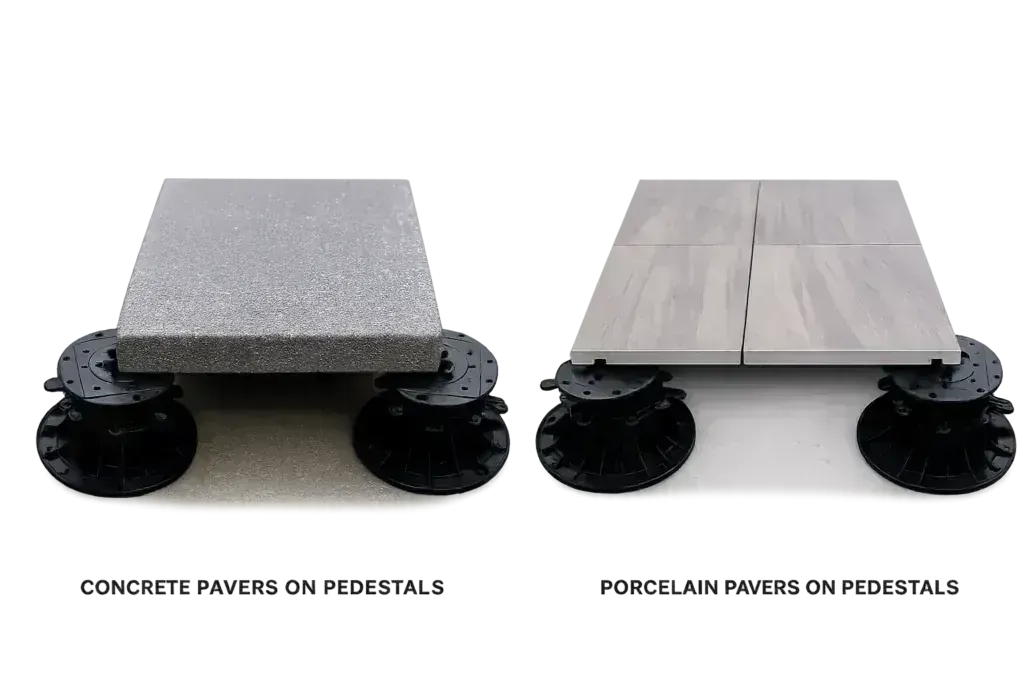
II. Concrete Pavers: The Traditional High-Utility Standard
Concrete pavers have been a trusted rooftop and deck surface material for decades.
They remain a strong choice for many commercial and residential projects, especially when durability and budget are major priorities.
Initial Cost Efficiency
One of concrete’s biggest advantages is cost.
Concrete pavers typically offer a lower entry price point than porcelain, making them attractive for:
- Large rooftop decks
- Multifamily developments
- Commercial amenity spaces
- Budget-sensitive projects
For projects with large square footage, those upfront savings can be significant.
Structural Density and Strength
Concrete pavers offer high compressive strength and excellent load-bearing performance.
They perform well under:
- Heavy foot traffic
- Outdoor furniture
- Rooftop gathering areas
- Commercial-use environments
Their density and strength make them a reliable long-term surface option.
Aesthetic Variety
Modern concrete pavers are available in a wide range of:
- Colors
- Textures
- Finishes
- Architectural styles
This makes them a versatile option for projects that want a more traditional or natural appearance.
SkyDeck Specification Quality
Not all concrete pavers are designed for pedestal systems.
SkyDeck USA utilizes high-quality concrete blends specifically selected for elevated pedestal applications, including pressed concrete pavers with less than 5% water absorption.
This helps ensure long-term rooftop performance, durability, and resistance to environmental exposure.
III. Porcelain Pavers: Gaining Popularity
While concrete remains a proven option, porcelain has become a popular option for many modern rooftop projects.
The long-term durability advantages are difficult to ignore.
Impermeability
One of porcelain’s biggest advantages is its extremely low water absorption rate—typically less than 0.05%.
That means:
- Water cannot penetrate the surface
- Freeze-thaw cracking is dramatically reduced
- Internal deterioration is minimized
This makes porcelain valuable in colder climates with repeated freeze-thaw cycles. Skydeck’s pressed concrete pavers also perform extremely well in harsh winter climates due to their low water absorption although not quite as low as porcelain pavers.
Stain and Chemical Resistance
Porcelain is highly resistant to:
- Oil stains
- Mold and mildew
- Environmental pollutants
This is particularly important in dense urban environments where rooftop surfaces experience constant exposure to dirt, debris, food spills, and pollution.
Although porcelain can be sensitive to harsh chemicals or cleaners. So, be sure to use cleaning products specifically made for porcelain pavers.
Weight Advantages
Porcelain pavers are significantly lighter than concrete, averaging approximately 9 lbs per square foot versus 22 lbs per square foot.
That lower weight can provide major advantages:
- Reduced structural load requirements
- Easier rooftop transportation
- Faster installation
- Lower labor strain during installation
For rooftop projects, weight matters—and porcelain can create meaningful efficiencies.
Fade Resistance
Porcelain and pressed concrete pavers are highly UV-stable although porcelain has a slightly higher color stability over decades, helping preserve the visual appearance and perceived value of the property long-term.
IV. Maintenance and Operational Expense Comparison
Maintenance costs play a major role in long-term ROI.
This is where the differences between porcelain and concrete become more nuanced.
Concrete Maintenance Requirements
Skydeck USA’s pressed concrete pavers feature less than 5% water absorption, making them significantly more durable and lower maintenance than many standard concrete products.
Their textured surfaces and natural variation also tend to visually hide everyday dirt, dust, and rooftop debris more effectively between cleanings.
For many projects, this helps reduce the appearance of wear over time.
Porcelain’s Low-Absorption Advantage
Porcelain offers major long-term advantages because of its near-zero water absorption and high resistance to internal cracking, freeze-thaw damage, and chemical staining.
However, in real-world rooftop environments, porcelain surfaces can sometimes show dirt, dust, pollen, and surface residue more visibly than concrete pavers—especially on lighter colors and smoother finishes.
As a result, porcelain pavers may require more frequent surface cleaning to maintain a pristine appearance.
Porcelain pavers also have a slightly higher propensity for cracking compared to concrete pavers, which is why tray systems, fiberglass grates, or safety backing systems are often recommended underneath the pavers for additional support and fall protection.
While porcelain performs extremely well long-term, individual units may require replacement more frequently than concrete in certain high-impact or high-traffic applications.
The right choice often depends on the priorities of the project:
- Porcelain for ultra-low absorption, modern aesthetics, lighter weight, and long-term color stability
- Concrete for durability, value, impact resistance, and lower day-to-day visual maintenance visibility
Repair Simplicity with the SkyJack Pedestal System
Both porcelain and concrete benefit from the SkyJack pedestal system’s repair accessibility.
If a paver becomes damaged, individual units can be removed and replaced without disturbing the surrounding deck.
That makes repairs faster, cleaner, and far less labor-intensive than traditional adhered systems.
But, concrete wins out in this category since porcelain tends to crack more easily. When ordering porcelain pavers, it’s important to keep extras on hand after the installation because dye lots can vary when replacing individual pavers in the future.
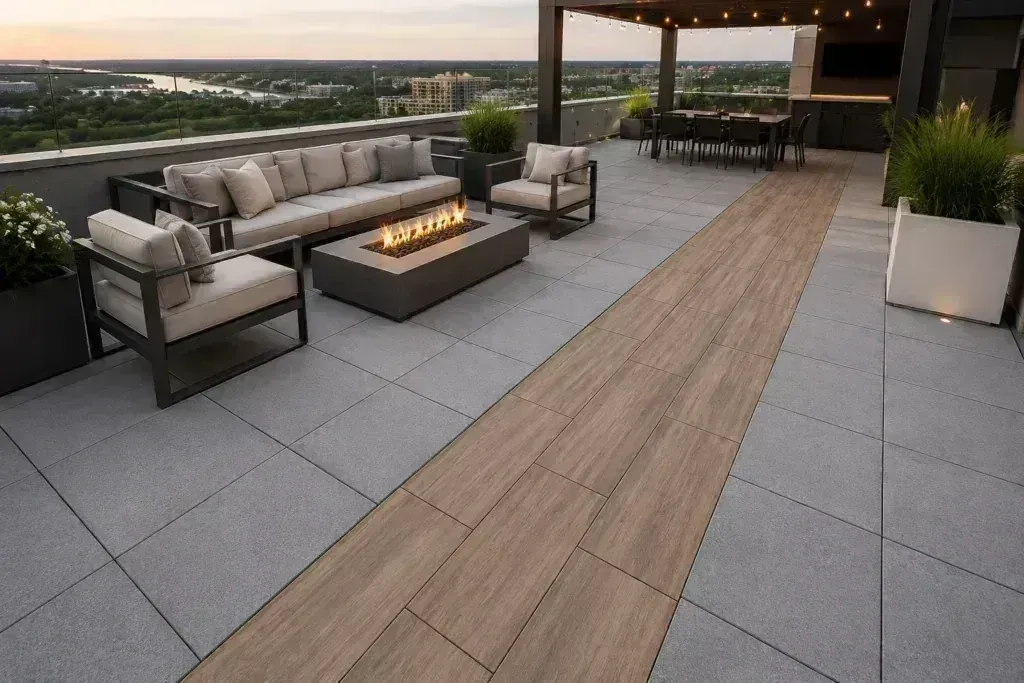
V. Installation Efficiency and Labor Impact
Installation labor is another major factor in ROI.
Faster Handling with Porcelain
Because porcelain is lighter than concrete, installers can move materials more quickly. But, since porcelain requires a grate system or trays underneath, that can require double the labor. Using Skydeck’s porcelain pavers with pre-installed safety backing speeds up installation making porcelain faster and easier to install as compared to competitor systems.
That improves:
- On-site productivity
- Crew efficiency
- Material staging speed
- Installer fatigue reduction
Over large projects, these labor savings become significant.
Cutting and Precision
Concrete and porcelain each require different cutting methods and tools.
Concrete is generally thicker and denser, but cuts can be made quickly with a wet table saw, chop saw or even a grinder.
Porcelain chips easily during cutting so they must be cut more slowly and precisely.
Universal Pedestal Compatibility
Both porcelain and concrete work seamlessly with Skydeck USA’s SkyJack pedestal system.
The fully adjustable “Twist-to-Adjust” pedestal system supports multiple paver thicknesses while maintaining fast installation speeds and long-term stability.
Combined with Skydeck USA’s detailed shop drawings and mapped pedestal heights, installers can move efficiently across the roof without guesswork or unnecessary adjustments.
VI. Environmental and Safety ROI
Material selection also affects environmental performance and rooftop safety.
Slip Resistance
Both porcelain and concrete pavers are available with high-friction surfaces designed to maintain slip resistance in wet conditions.
This helps projects meet safety requirements while improving rooftop usability.
Thermal Performance
Lighter-colored porcelain or concrete pavers can help keep rooftop surfaces and the building below significantly cooler by reflecting more solar heat instead of absorbing it. This reduction in heat transfer can help lower rooftop temperatures, reduce HVAC workload, improve occupant comfort, and decrease long-term energy costs—especially during hot summer months and in dense urban environments where heat buildup is more extreme.
Sustainability and Longevity
Porcelain and concrete pavers both have a long lifespan, lasting 30 plus years with proper maintenance.
That means:
- Less material waste
- Lower landfill contribution
- Reduced lifecycle material consumption
Long-lasting materials are often the most sustainable materials.
VII. Skydeck USA’s Strategic Consultation Services
Choosing the right rooftop material is not a one-size-fits-all decision.
Material Mapping and Project Planning
Skydeck USA can help property owners evaluate:
- Climate exposure
- Foot traffic levels
- Rooftop usage goals
- Maintenance expectations
This helps ensure the right material is selected for the specific project.
Technical Specifications and SRI Data
Skydeck USA provides technical product information including:
- Load-bearing data
- Surface performance characteristics
- Solar Reflectance Index (SRI) ratings
- Material specifications
This allows architects, contractors, and property owners to make informed decisions based on long-term performance goals.
System Longevity Assurance
The surface material is only part of the system.
Skydeck USA helps ensure the pedestal foundation is designed to support the long-term lifespan of both porcelain and concrete rooftop assemblies.
Combined with detailed pedestal layout drawings and installation planning, the entire rooftop system is designed for durability and long-term performance.
VIII. Conclusion: Making the Data-Driven Choice
Both porcelain and concrete pavers can be excellent rooftop solutions when paired with the right pedestal system. The best choice depends on the goals of the project.
Concrete pavers are durable, cost-effective, impact-resistant, and often better at hiding everyday dirt and wear. With low water absorption and strong freeze-thaw performance, they perform well in both hot and cold climates.
Porcelain’s biggest advantage is design flexibility. It offers a wider variety of colors, textures, and modern finishes. Porcelain is also lighter on its own, although the required tray or grate support system may reduce some of that weight advantage.
Both materials have tradeoffs. Porcelain may show dirt more easily and has a slightly higher risk of cracking, while concrete is heavier but often more forgiving in real-world rooftop conditions.
The smartest choice comes down to the project’s:
- Budget
- Design goals
- Structural requirements
- Maintenance expectations
- Long-term use
Visit SkyDeckUSA.com to request material samples, technical specifications, and project-specific ROI guidance.